Personal Gas Monitoring for Field Teams
Personal gas monitoring for teams working in the field.
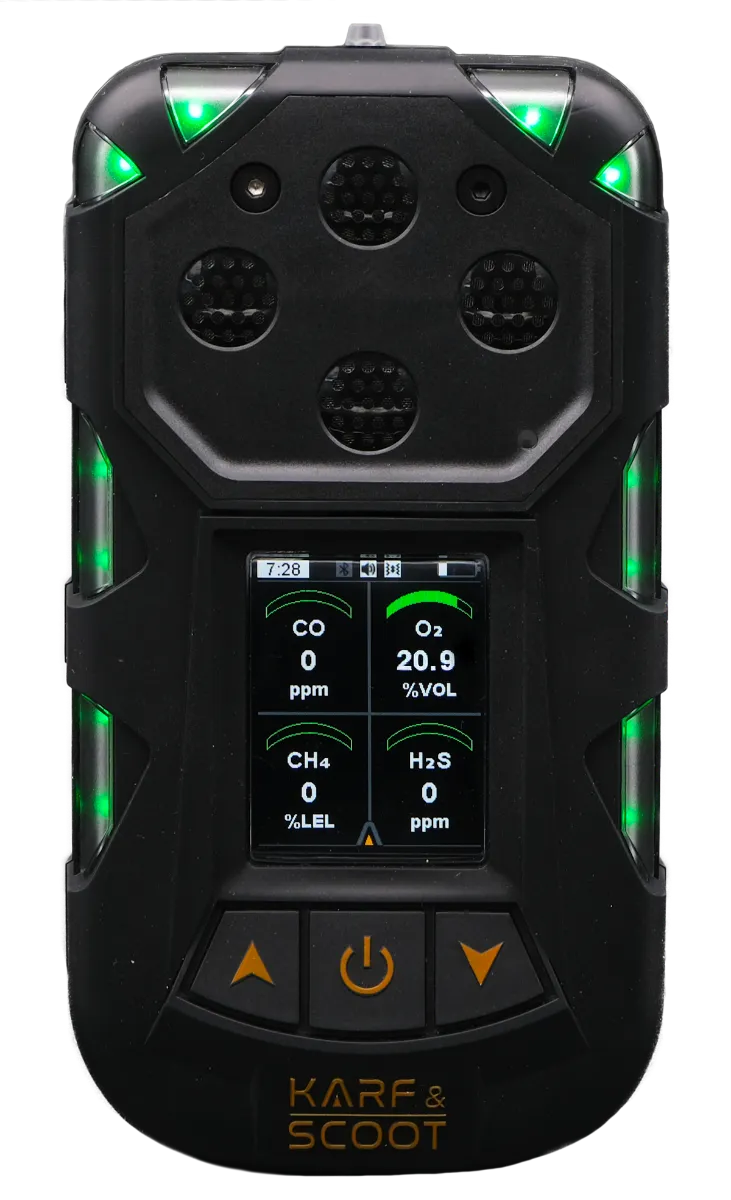


A portable detection solution for teams that need to monitor multiple gas hazards with a single device.

A single-gas detector that personnel can carry with them to monitor a toxic gas or oxygen.
A portable gas detector is a personal gas detection device that a worker carries and that measures hazardous gases in the surrounding air in real time. It is also known as a personal gas monitor. Portable gas detectors monitor gas hazards directly in the user’s breathing zone, at points that fixed gas detection systems do not cover. Typical examples include entry into confined spaces such as tanks, wells and sewers, maintenance and repair work, and teams that move from one location to another on site. When the gas level exceeds the set alarm threshold, the detector immediately warns the user with audible, visual and vibrating alarms, keeping personnel safe.
Portable gas detectors fall into two groups based on how many gases they monitor: single-gas detectors and multi-gas detectors. Single-gas detectors monitor one toxic gas, such as carbon monoxide, hydrogen sulfide or ammonia, or the oxygen level, in environments where the hazard is known. They are lightweight, need little maintenance and offer long battery life. Multi-gas detectors measure combustible gases (%LEL), oxygen and several toxic gases at the same time, which makes them the preferred choice for confined space work where gas hazards can change. Karf&Scoot offers the BELLMINI™ portable gas detector for single-gas monitoring and the GDP-F6 for multi-gas monitoring.
Portable gas detectors used in areas with a risk of explosive atmospheres must carry ATEX and/or IECEx certification. The GDP-F6 and BELLMINI™ portable gas detectors are certified with the intrinsically safe (Ex ia) type of protection. With this type of protection, the device’s circuitry cannot produce enough energy to cause ignition, even under fault conditions. The device itself therefore does not become an ignition source and can be used safely in Zone 0, 1 and 2 potentially explosive atmospheres.
Karf&Scoot portable gas detectors come with alarm and data features designed to make sure hazards are noticed in any condition:

A portable gas detector measures hazardous gases in the worker’s breathing zone in real time and gives early warning of gas-related poisoning, asphyxiation and explosion risks. When the gas level exceeds the alarm threshold, it alerts the user with audible, visual and vibrating alarms. This allows the worker to leave the area before the hazard escalates.
Choose a single-gas detector if the hazard is limited to one known gas, and a multi-gas detector if the gas hazard is variable or involves more than one gas. Ammonia in a refrigeration plant or carbon monoxide in a boiler room are examples of single-gas applications. For confined space entry, a multi-gas detector that measures oxygen, combustible gases and toxic gases at the same time is the preferred choice. Within the Karf&Scoot range, BELLMINI™ provides single-gas monitoring, while GDP-F6 measures up to 6 gases.
Before entering a confined space, test for oxygen first, then combustible gases, then toxic gases. Oxygen is tested first because the catalytic sensors used to measure combustible gases need sufficient oxygen to give accurate readings (OSHA 1910.146 Appendix B). In practice, the most commonly monitored gases are oxygen (O₂), combustible gases (%LEL), carbon monoxide (CO) and hydrogen sulfide (H₂S), which is why multi-gas detectors are used for confined space work.
An oxygen detector should alarm when the oxygen concentration drops below 19.5% or rises above 23.5%. Normal air contains about 20.9% oxygen. OSHA defines these two limits as oxygen deficiency and oxygen enrichment (OSHA 1910.146). Deficiency creates a risk of asphyxiation, while enrichment creates a fire risk. Portable gas detectors should therefore have both low and high oxygen alarms.
A portable gas detector should be bump tested (function tested) before each day’s use, and fully calibrated at the intervals specified by the manufacturer. A bump test confirms that the sensors respond correctly to gas and that the alarms work. If the device fails this test, it needs a full calibration before it can be used (OSHA SHIB 09-30-2013).
A portable gas detector used in explosive atmospheres must be ATEX (2014/34/EU) and/or IECEx certified. In the European Union and Türkiye, equipment intended for use in potentially explosive atmospheres falls under the ATEX directive (EU-OSHA). The most common type of protection for portable detectors is intrinsic safety (Ex ia), in which the device’s circuitry cannot produce enough energy to cause ignition. Karf&Scoot GDP-F6 and BELLMINI™ are ATEX-certified with Ex ia protection.